Saturday, June 9, 2012

Gone Picking!

Springtime is a great time of year to be outside: the sun is shining, leaves are returning to the trees, plants are growing and flowers are blooming, and all kinds of creatures are out and about. In the month of May, some very special plants are growing in our valley. A few weeks ago, Brenda and Irene took our Division 2 class out to the Botany Valley to pick sTweta and Tatoon: wild spinach and wild potatoes. What an adventure we had! 

 As we soon discovered, picking Tatoon is harder than it looks. We came with spoons and sticks and even some crow-bars to dig up our Tatoon. The first thing you need to do when picking Tatoon is look for patches of white flowers. We were lucky, because the field we found was just covered in blooms! It was like an ocean of tiny petals.


Check out this video of a Division 2 student digging for Tatoon. She is using a spoon to try and wedge the roots of the Tatoon plant up and out of the soil. 


Here's the potato she ended up uncovering from the Tatoon plant she dug up! 


Even though the digging was tough, we had a lot of success. The Tatoon we found varied in size from potatoes as tiny as peas to ones as giant as baseballs. When we cooked these up later, back at school, we discovered that they tasted a lot like the potatoes you can buy at the grocery store. We boiled them and then fried them in margarine to make them crispy on the outside! Mmmmm!

A crowbar makes a great digging tool.
Teamwork makes the job easier!


We also found an excellent spot for picking sTweta. sTweta is easy to spot because it has bright yellow flowers and very distinctive leaves. The leaves are long and rounded - they look a little bit like fingers! sTweta also has a really delicate sweet smell, so it's easy to tell if you're picking the right plant! It tastes great freshly picked, especially the white root tips, but it also tastes yummy when it's steamed with a little melted butter on top. We tried it both ways, and it was delicious! 

The sTweta grows on hillsides.
This student picked a whole bag full!
We were very fortunate to have an elder join us on our picking trip. Ellen showed us how to dig up Tatoon and how to spot sTweta. She shared some stories with us about picking when she was growing up. Thank-you, Ellen, for teaching us about picking! 

Ellen holds up a sTweta plant. You can see its white roots and long green leaves.
Thanks also to Irene and Brenda, who organized our trip! 


Leave us a comment:

How many Tatoon did you dig up?

What is your favourite traditional food?

What other things do you like to pick in the springtime? 

Sunday, June 3, 2012

Jevan's Post about The Humming Birds and The Peafowl

Back in November, Jevan was the winner of our Family Blogging Month challenge. Jevan and his family commented on our blog 29 times in the month of November! Wow! This is Jevan's post about some special creatures that live with him on his ranch.

****

At my Ranch there are lots of Humming birds.Usually right before night they come out to eat.They are attracted to red things like my humming bird feeders. They drink water with sugar in it. Can you count how many humming birds are in the video?


My mom and I made this video about the Hummingbirds that visit our house. You can also see our peafowl.

At my Ranch I have 4 peafowl: 3 peacocks and 1 peahen.The boys are Stewart, Russel, and Sam.The Girl is Queenie. Can you tell which one is Queenie? She looks different from the  boy peacocks because she doesn't have the big fancy feathers. Right now I have 2 peafowl eggs in our in incubator that we are trying to hatch. The incubator helps the eggs keep warm so they will hatch.

Can you spot Queenie, the peahen? 

Leave Jevan a comment:

Do you have Humming birds at your house?

How many humming birds have you seen at your house?


Do you have any peafowl at your house? How many?


What other animals do you have at your house? 

Wednesday, May 9, 2012

Adventures in 3d

In Math, we are learning about 3d shapes. In a drawing experiment one morning, we discovered that 3d shapes look different depending on what your view is.

For example, if you look at this shape from the front, you can see a house. The house is made of a triangular prism sitting on top of a rectangular prism. There is a cylinder-shaped window in the middle of the rectangular prism.

front view
But from the side, the house suddenly looks like a long, skinny rectangle.

side view

 And from the top, the roof just looks like a short rectangle.

top view
That's why when we drew this shape, every one of our drawings was unique - we were all looking at the house from a different point of view!

click on the photo to see our drawings up close

In Art, we built 3d solids out of paper and used geometric designs to decorate their faces and curved surfaces. Can you take a look at different views of these shapes and guess what solid each Division 2 student is holding?

What shape is this student holding?
bottom view
side view


top view


What shape is this student holding?
bottom view
side view

top view

unicorn view
What shape is this student holding? 

side view
top view


A paper map that is used to build a solid 3d shape is called a net. You can use the net of an object as a clue to help you figure out what 3d object it will be once it's built. All you have to do is look at the faces: how many faces are there and what shape are they? Riannon built the 3d solid below. Can you tell from looking at its faces what kind of 3d object it is?


Division 2's 3d solids

Leave us a comment: 


What 3d shape is your favourite? How many faces does it have? 


Can you find any objects in your house that are the same shape as these 3d objects?

Sunday, May 6, 2012

Salmon inside-out

Back in April, Division 2 had a special visitor! Kevin came to our classroom to teach us about how a salmon survives in the river. He brought an adult salmon with him, and then he dissected it so we could see all the different body parts that help a salmon stay alive. 

This is an adult male salmon. Can you see its hook nose?
First Kevin showed us how to tell if an adult salmon is a male or female. This adult salmon is a male. You can tell because its sides are dark red and it has a hooked nose. Male and female salmon are different on the inside, too. A male salmon has two milt sacs and a female salmon will have hundreds of eggs! We saw male and female salmon just like this one, that were ready to spawn, when we visited Adam's River salmon run this September. 


The outside of a salmon's body helps it survive in the water. It has sticky slime all over its body to help it swim fast and slip away from predators. Do you know what animals prey on salmon? Salmon's body's are also covered in scales. Kevin showed us that a fish's scales are like a tree trunk - they have growth rings! You can look at the number of rings on a salmon's scales to tell how old a salmon is. We got to look at the salmon's scales through magnifying glasses. What other tool could you use to see a fish scale up close? 
  
Kevin removes the milt sacs from the salmon. 
Kevin showed us all the different organs you can find inside an adult salmon's body. !He told us how each one has its own job to do in order to keep the salmon alive. We got to take a close look at each organ. It got a little bloody ... but we didn't mind!


At the end of the dissection, we got a special demonstration from Kevin. He showed us how to fillet the salmon and slice it into pieces for drying. In Lytton, many people air dry the salmon with a little bit of salt to make stwen. We talked about all the different ways to cure a salmon, and discovered that some of our families can salmon, air dry salmon, and smoke salmon. Mmm! Have you ever filleted a salmon before? 

Kevin shows us how to slice the fillet to make stwen.


Can you guess what these different organs are? Leave your answers as a comment below! 

Organ #1 
Clue: This organ digests the food that the salmon eats. 


Organ #2 
Clue: Without this organ, a salmon would sink.


Organ #3 
Clue: This organ helps a fish collect something very valuable from the water - oxygen!


Organ #4
Clue: This organ is actually a pump made of strong muscle.
Like a house with different rooms, ours has four rooms, but a salmon's only has 2!


Organ #5
Clue: This organ has a twin, but they can both move on their own
to help a salmon see above and below itself at the same time!


Saturday, March 31, 2012

Elder's Tea

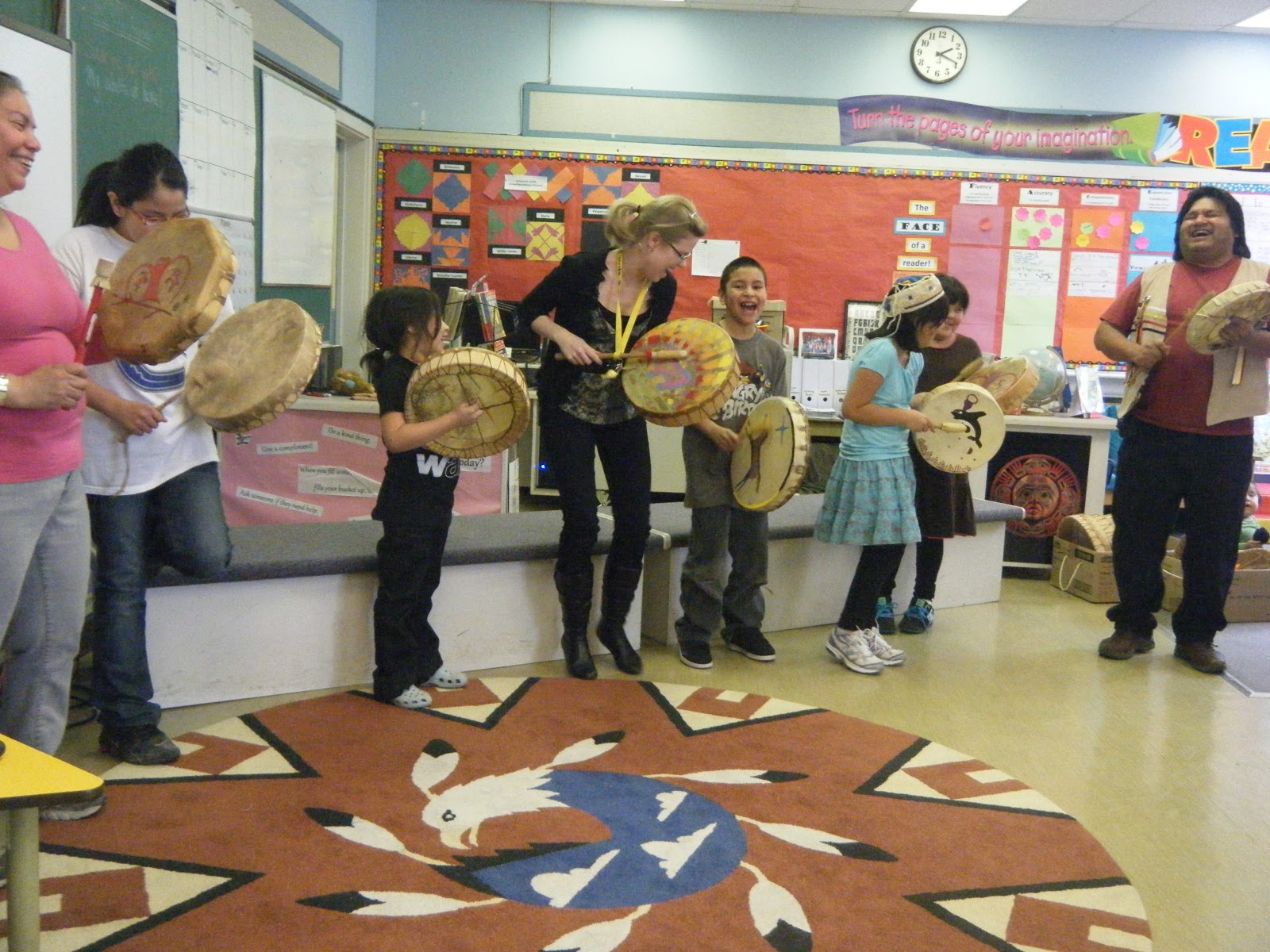
Last week, on March 27th, Division 2 hosted our Elders and community members for our school's monthly Elder's Tea. Our class worked hard to prepare for Elder's tea, learning how to play the drum and learning the rhythm and words of many new drumming songs. When our Elders arrived, we played them a Welcome song.


Click on the video above to hear a complete recording of our Welcome song.  


After our Welcome, we showed our Elders the other songs we learned to play with Harvey.  Even though they were a bit nervous to play for an audience for the first time, Division 2 did an excellent job of drumming and singing with confidence. Some brave volunteers sang the Laughing song for our guests, and we even got some parents up to play with us!

The Laughing song was a big hit!
After drumming, we shared snacks with our guests and showed them around our classroom. There were so many smiling faces at our Elder's Tea this month.

Baby sisters get in on the drumming.
Riannon's own drum.
Lots of hugs to go around.
Check out those smiles!
There was lots of love for the little ones! 
We had a great turn out.
Three generations of ladies!
Families had a chance to check out some of our awesome art work. 
What a fantastic afternoon!


Leave us a comment: 


Which of your family members and Elders came to our Elder's tea? 


What was it like to perform in front of an audience? 


What was your favourite part of the Elder's tea?